Wolff Rearrangement
时间: Invalid Date
作者: 百灵威
分享:
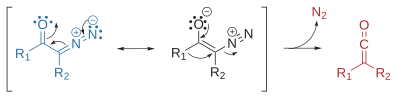
The Wolff rearrangement uses either catalytic silver oxide, heat, or light to convert an α-diazo ketone to a ketene. In a one-step reaction, the catalyst initiates a 1,2-shift to release nitrogen gas and produce ketene. Due to the release of nitrogen gas, this reaction should not be performed in a closed system.
Lab Tips:- Thermal catalysis is not ideal as delicate substrates may degrade and side reactions such as the direct displacement of the diazo group without rearrangement frequently occur. [1]
- Photochemical activation is convenient and takes place even at low temperatures, but only if the product is not photolabile. [1]
- Silver catalysts are generally used as they lower the required reaction temperature considerably compared to the thermal process. [1]
- If the migrating group has a stereocenter, there is net retention of configuration after the migration. [1]
- Cyclic diazo ketones undergo ring-contraction. [1]
- Numerous side reactions are possible since α-diazo ketones are very reactive. Careful choice of reaction conditions can avoid/minimize these side reactions. [2,3]
2. Gill, G. B. The Wolff Rearrangement. Comp. Org. Synth. 1991, 3, 887-912.
3. Kirmse, W. 100 Years of the Wolff rearrangement. Eur. J. Org. Chem. 2002, 14, 2193-2256.
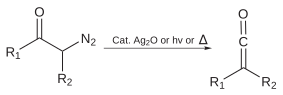
- Reagents: Catalytic Ag2O/silver(I) benzoate or Δ or light
- Reactant: α-Diazo Ketone
- Product: Ketene
- Type of Reaction: Rearrangement
- Bond Formation: O=C=C
Mechanism
Original Paper
Top Citations
Related Reactions
- Arndt-Eistert Synthesis
Related Compounds
- Catalytic Ag2O (CAS 20667-12-3)

服务科技与工业发展 造福人类

关注微信公众号

北京市朝阳区大望京中心A座501
电话(QQ): 400 666 7788
电话:+86 10 59309000
传真:+86 10 8284 9933
本网站销售的化学产品仅供研发或工业应用,不直接用于食品、药品、临床诊断或治疗。
