时间: Invalid Date
作者: 百灵威
分享:
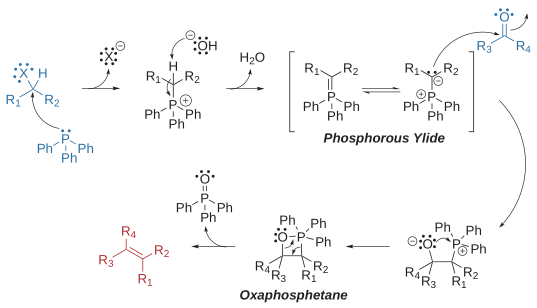
The Wittig reaction uses triphenylphosphine (PPh3), a base, and a 1° or 2° alkyl halide to convert an aldehyde or ketone to an olefin. First a phosphonium salt is made when the PPh3 attacks the alkyl halide, releasing a halide ion in the process. The α-hydrogen is then deprotonated by the base, creating a phosphorus ylide, which attacks the aldehyde or ketone, forming a cis or trans betaine intermediate. Rearrangement of the resulting oxaphosphetane produces the final E/Z olefin product.
Lab Tips:- Phosphorus ylides selectively react with aldehydes and ketones, leaving esters and amides intact. [1]
- Care must be taken when handling the ylide as it is water and oxygen-sensitive. [1]
- E-or Z-selectivity is influenced by the type of ylide (stabilized, semi-stabilized, nonstabilized), steric effects that develop as the ylide and carbonyl compound approach each other, and the nature of the solvent and base. [1,2]
- Stabilized and nonstabilized ylides tend to provide greater stereoselectivity than semi-stabilized ylides. Under salt-free/dipolar aprotic conditions with aldehydes for instance, stabilized ylides give predominantly (E)-olefins, nonstabilized ylides afford olefins with high (Z)-selectivity, while semi-stabilized ylides usually afford a more even mixture. [1,2]
- Tetrasubstituted alkenes cannot be prepared because of steric hindrance. [3]
- Carrying out this reaction on a solid support allows easy separation of the products from triphenylphosphine oxide. [1].
2. Carey, F.A., Sundberg, R.J. (2001). Advanced Organic Chemistry Part B: Reactions and Synthesis (4th ed.). New York: Kluwer Academic/Plenum Publishers.
3. McMurry, J. (2000). Organic Chemistry (5th ed.). Pacific Grove, CA: Brooks/Cole.

- Reagents: Triaryl- or trialkylphosphine, Base (RLi, NaH, NaOR, etc.), Solvent (THF, Et2O, DME, MTEB, or toluene)
- Reactant: 1° or 2° Alkyl Halide (Cl, Br, I, OTs), Aldehyde or Ketone
- Product: Olefin
- Type of Reaction: Nucleophilic Addition of Phosphorus Ylides
- Bond Formation: C=C
Mechanism
Original Paper
Top Citations
Related Reactions
- Corey-Chaykovsky Reaction
- Julia Olefination
- Peterson Olefination
- Schlosser Modification
- Seyferth-Gilbert Homologation
- Tebbe Olefination
- Wittig-Horner Reaction
Related Compounds

100万+品类
全品全覆盖,海量现货高品质

50万+瓶现货
可实现最快4小时送达

28万+服务客户
提供产品及配套技术服务
联系我们


关注微信公众号
本网站销售的化学产品仅供研发或工业应用,不直接用于食品、药品、临床诊断或治疗。
