时间: Invalid Date
作者: 百灵威
分享:
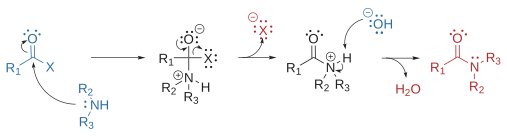
The synthesis of amides from amines and esters from alcohols with acyl halides or anhydrides in the presence of a base is known as the Schotten-Baumann reaction. The amine attacks the acyl halide, forming a tetrahedral intermediate that releases a halide ion. Deprotonation of the positively charged nitrogen affords the amide product. Esters are formed from alcohols in a similar fashion.
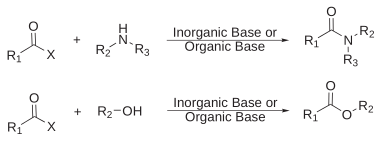
- Reagents: Original Conditions: Inorganic Base (NaOH, KOH, Na2CO3, NaHCO3), Water or Modified Conditions: Aprotic Solvent, Organic Base (Pyridine, DMAP, Et3N, etc.) and/or Lewis Acid (MgBr2, Sc(OTf)3, etc.)
- Reactant: Acyl Halide or Anhydride, 1° or 2° Amine, 1°, 2° or 3° Alcohol
- Product: Amide or Ester
- Type of Reaction: Nucleophilic Acyl Substitution
Mechanism
Original Paper
Top Citations
Related Compounds

100万+品类
全品全覆盖,海量现货高品质

50万+瓶现货
可实现最快4小时送达

28万+服务客户
提供产品及配套技术服务
联系我们


关注微信公众号
本网站销售的化学产品仅供研发或工业应用,不直接用于食品、药品、临床诊断或治疗。
