Ritter Reaction
时间: Invalid Date
作者: 百灵威
分享:
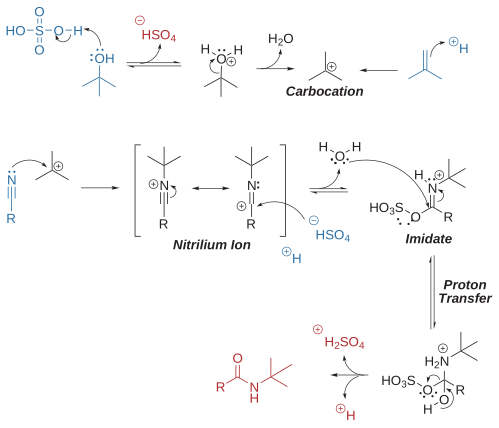
The Ritter reaction uses a strong protic acid and water or a solvent to convert a nitrile and a carbocation precursor molecule to an amide product. First the precursor molecule becomes a carbocation, which is attacked by the nitrogen atom of the nitrile to form a nitrilium ion. An imidate is then formed when the conjugate base of the acid (hydrogen sulfate anion in this case) adds to the nitrilium ion. Hydrolysis produces the desired N-substituted amide product.
Lab Tips:- The alcohol or alkene is usually added to the nitrile substrate (classically dissolved in a mixture of acetic acid and concentrated sulfuric acid) at slightly elevated temperatures (50 – 100°C).
- Lewis Acids such as SnCl4, AlCl3, etc. can also be employed to generate the required carbocation.
- Besides aliphatic and aromatic nitriles, cyanogen and cyanamide are also substrates.
- The initial carbocation may undergo a Wagner-Meerwein rearrangement to generate the most stable carbocation before reacting with the nitrile.
- 1,1-disubstituted alkenes give rise to regioisomerically pure products, while 1,2-disubstituted alkenes may form a mixture of regioisomers.

- Reagents: Strong Protic Acid (H2SO4, HClO4, HCO2H, etc.), H2O or Solvent (Acetic Acid, H2SO4 (conc.), CHCl3, etc.)
- Reactant: Aliphatic or Aromatic Nitrile, Carbocation Precursor (Alkene, Alkyl Halide, 2°, 3° or Benzylic Alcohol)
- Product: N-Substituted Amides
- Type of Reaction: Addition
- Bond Formation: N-C, N-H, C-C, C=O
Mechanism
Original Paper
Top Citations
Related Reactions
- Synthesis of Amides
- Synthesis of Protected Primary Amines
Related Compounds
- Nitrile

服务科技与工业发展 造福人类

关注微信公众号

北京市朝阳区大望京中心A座501
电话(QQ): 400 666 7788
电话:+86 10 59309000
传真:+86 10 8284 9933
本网站销售的化学产品仅供研发或工业应用,不直接用于食品、药品、临床诊断或治疗。
