Reimer-Tiemann Reaction
时间: Invalid Date
作者: 百灵威
分享:
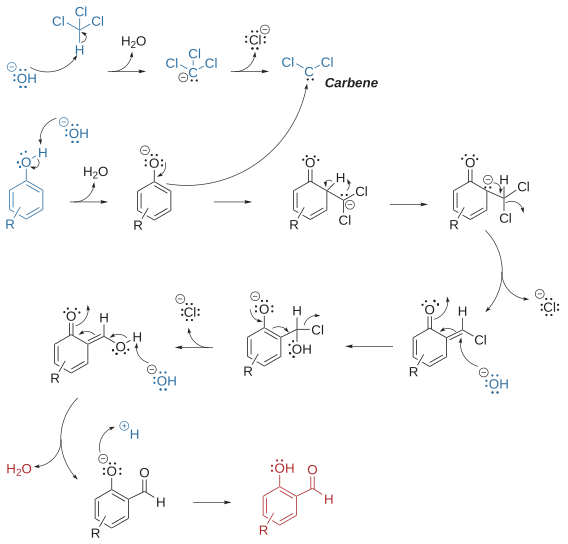
The Reimer-Tiemann reaction uses a dichlorocarbene precursor molecule such as chloroform, an alkali hydroxide, and a protic solvent to convert a phenol to an ortho-formyl phenol. The base first abstracts the hydrogen from chloroform, creating a trichlorocarbanion, which loses a chloride ion to form dichlorocarbene. Phenol is then deprotonated by the base, delocalizing electrons into the ortho position of the ring, which attack the carbene. An internal proton transfer and release of a chloride ion forms a carbon-carbon double bond, which hydroxide adds to, resulting in the release of the last chloride ion. Tautomerization produces the final product.
Lab Tips:
- Phenol is typically dissolved in a 10-40% aqueous solution of an alkali hydroxide, to which excess chloroform is added. The resulting biphasic solution should be vigorously stirred at around 60°C for about three hours.
- Ortho-formyl products tend to predominate, but when this position is already substituted, para-formyl phenols are obtained.
- Alkyl-, alkoxy- and halogenated phenols, naphthols, salicylic acid derivatives, heterocyclic phenols such as hydroxyquinolines and hydroxypyrimidines, pyrroles and indoles also undergo formylation under these reaction conditions.
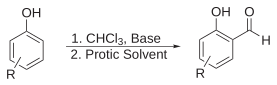
- Reagents: CHCl3, Base (NaOH, KOH, or CsOH), Protic Solvent
- Reactant: Phenol
- Product: Ortho-Formyl Phenol
- Type of Reaction: Electrophilic Aromatic Substitution
- Bond Formation: Ph-CH=O
Mechanism
Original Paper
Top Citations
Related Compounds

服务科技与工业发展 造福人类

关注微信公众号

北京市朝阳区北辰西路69号峻峰华亭A座5层 100029
电话(QQ): 400 666 7788
电话:+86 10 59309000
传真:+86 10 8284 9933
本网站销售的化学产品仅供研发或工业应用,不直接用于食品、药品、临床诊断或治疗。
