Mukaiyama Aldol Addition
时间: Invalid Date
作者: 百灵威
分享:
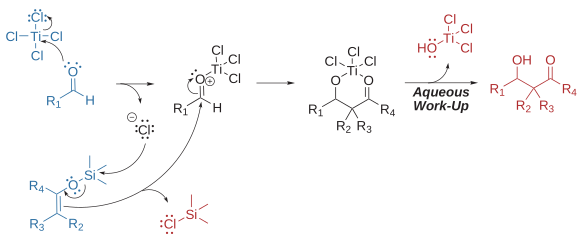
The Mukaiyama aldol reaction uses a catalytic Lewis acid (e.g. TiCl4) or base, and an aqueous work-up to convert an aldehyde and an E- or Z-enol silane to an anti- and/or syn-diastereomer 1,3-ketol. The aldehyde is activated for nucleophilic attack when it coordinates to the Lewis acid, releasing a chloride ion in the process. The chloride ion then attacks the enol silane, forming TMSCl and an enolate, which attacks the aldehyde to afford the 1,3-ketol. The stereochemical outcome is based on the substrates and conditions used.

- Reagents: Lewis Acid or Base (Stoichiometric, Substoichiometric, or Catalytic), Aqueous Work-Up
- Reactant: Aldehyde, Z-or E-Enol Silane (Aldeyhyde, Ketone, Ester, or Thioester Derived)
- Product: 1,3-Ketol
- Type of Reaction: Lewis Acid Catalyzed Aldol Addition of Enol Derivatives
Mechanism
Original Paper
Top Citations
Related Compounds

服务科技与工业发展 造福人类

关注微信公众号

北京市朝阳区大望京中心A座501
电话(QQ): 400 666 7788
电话:+86 10 59309000
传真:+86 10 8284 9933
本网站销售的化学产品仅供研发或工业应用,不直接用于食品、药品、临床诊断或治疗。
