双吖丙啶光交联剂——助力蛋白相互作用、活性小分子靶点研究
时间: 2021-03-09
作者: 百灵威
分享:
随着质谱和生物信息学在化学探针中的应用,科学家们已发现越来越多的生物靶标在医学研究和药物发现中起着至关重要的作用(图1)。PAL(光亲和标记)是生物系统中识别靶标或结合位点的有力工具[1],它包括四种常用的光反应基团,即芳基叠氮类(AZs)、二苯甲酮类(BPs)、双吖丙啶类(DAs)和2-芳基-5-羧基四唑类(ACTs)。在特定波长的紫外激发下,相应的中间体分别为氮宾、双自由基、卡宾和羧基腈亚胺。其中卡宾介导的光亲和标记被广泛用于药物靶标识别。
![图1 Development of genetically encoded photocrosslinker with a transferable MS-label. (a) In situ generation of MS-label on prey proteins by using a genetically encoded cleavable photocrosslinker. (b) Chemical design of the photocrosslinker (DiZHSeC) with transferable MS-label. The in situ generated NPAA MS-label can be verified by either fluorogenic labelling or can be directly identified by mass spectrometry<sup>[1]</sup>.](https://shop.jkchemical.com/res/0-5929.jpg)
图1 Development of genetically encoded photocrosslinker with a transferable MS-label. (a) In situ generation of MS-label on prey proteins by using a genetically encoded cleavable photocrosslinker. (b) Chemical design of the photocrosslinker (DiZHSeC) with transferable MS-label. The in situ generated NPAA MS-label can be verified by either fluorogenic labelling or can be directly identified by mass spectrometry[1].
百灵威提供一系列双吖丙啶类光交联剂,可用于
- 蛋白相互作用研究[1];
- 活性小分子的靶蛋白识别[2-4]。
产品优势
- 反应活性高:光照激活后的卡宾具有高化学活性,更利于捕捉目标蛋白。
- 位阻小:相较芳基叠氮类(AZs)、二苯甲酮类(BPs)等光交联剂,位阻更小,研究对象更易保持原有生物活性。
- 稳定性好:在自然光照、室温、一定酸碱浓度条件下稳定性好,便于进行实验操作。
- 连接方便:模块化设计提供端基为-COOH、-OH、-NH2、-I的成品探针,方便与底物分子或蛋白连接。
- 结构灵活、可定制:可根据实验需求定制不同臂长与端基的光亲和交联剂,获得良好实验结果(图2)。

图2 可定制不同臂长与端基的光亲和交联剂
产品列表
1

品名:
3-(3-(But-3-yn-1-yl)-3H-diazirin-3-yl)propanoic acid, 97%
3-(3-(丁-3-炔-1-基)-3H-重氮基丙因-3-基)丙酸
CAS:1450754-37-6
货号:9058717
3-(3-(But-3-yn-1-yl)-3H-diazirin-3-yl)propanoic acid, 97%
3-(3-(丁-3-炔-1-基)-3H-重氮基丙因-3-基)丙酸
CAS:1450754-37-6
货号:9058717
2
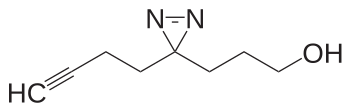
品名:
3-(3-(But-3-yn-1-yl)-3H-diazirin-3-yl)propan-1-ol, 97%
3-(3-(丁-3-炔-1-基)-3H-重氮基丙因-3-基)丙烷-1-醇
CAS:1846565-95-4
货号:9190166
3-(3-(But-3-yn-1-yl)-3H-diazirin-3-yl)propan-1-ol, 97%
3-(3-(丁-3-炔-1-基)-3H-重氮基丙因-3-基)丙烷-1-醇
CAS:1846565-95-4
货号:9190166
3
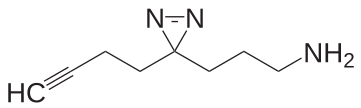
品名:
3-(3-(But-3-yn-1-yl)-3H-diazirin-3-yl)propan-1-amine, 97%
3-(3-(丁-3-炔-1-基)-3H-重氮基丙因-3-基)丙烷-1-胺
CAS:N/A
货号:9190167
3-(3-(But-3-yn-1-yl)-3H-diazirin-3-yl)propan-1-amine, 97%
3-(3-(丁-3-炔-1-基)-3H-重氮基丙因-3-基)丙烷-1-胺
CAS:N/A
货号:9190167
4
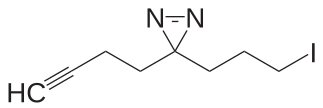
品名:
3-(But-3-yn-1-yl)-3-(3-iodopropyl)-3h-diazirine, 97%
3-(丁-3-炔-1-基)-3-(3-碘丙基)-3H-重氮基丙因
CAS:N/A
货号:9190168
3-(But-3-yn-1-yl)-3-(3-iodopropyl)-3h-diazirine, 97%
3-(丁-3-炔-1-基)-3-(3-碘丙基)-3H-重氮基丙因
CAS:N/A
货号:9190168
参考文献
- Yang, Y., Song, H., He, D. et al. Genetically encoded protein photocrosslinker with a transferable mass spectrometry-identifiable label. Nat Commun 7, 12299 (2016).
- Design and Synthesis of Minimalist Terminal Alkyne‐Containing Diazirine Photo‐Crosslinkers and Their Incorporation into Kinase Inhibitors for Cell‐ and Tissue‐Based Proteome Profiling[J]. Angewandte Chemie, 2013, 125(33).
- Parker C G , Galmozzi A , Wang Y , et al. Ligand and Target Discovery by Fragment-Based Screening in Human Cells[J]. Cell, 2017, 168(3):527.
- Species selective diazirine positioning in tag-free photoactive quorum sensing probes.[J]. Chemical Communications, 2013.

服务科技与工业发展 造福人类

关注微信公众号

北京市朝阳区北辰西路69号峻峰华亭A座5层 100029
电话(QQ): 400 666 7788
电话:+86 10 59309000
传真:+86 10 8284 9933
本网站销售的化学产品仅供研发或工业应用,不直接用于食品、药品、临床诊断或治疗。
