Cleaning, Sanitizing, Disinfecting, and Sterilizing: What is the Difference?

Cleaning, sanitizing, and disinfecting our homes and workplaces are great ways or cleaning ourselves and our families safe and healthy, but what do these terms mean, and how do they differ from each other?
Cleaning
Cleaning is the process of removing microbes and visible dirt from a surface. Cleaning is usually performed to remove pathogens from the surface of an object so they are safe to either handle, use, or discard, and involves the use of water, detergent or soap, and manual scrubbing. While this process reduces the number of microbes and in turn, the risk of spreading infections, it does not kill microbes.
Sanitizing
Sanitizing is the reduction of bacteria, viruses, and fungi on a surface by 99.9% within 10 minutes. It can be done with EPA (Environmental protection agency) approved sanitizer products or bleach which can both clean and sanitize an object depending on the concentration and dwell time.
Disinfecting
Disinfecting is the elimination of vegetative cells and microbes on inanimate surfaces by 99.999% yet does not eliminate spores and requires that the disinfectant “dwells” or remains in contact with the surface for longer periods. Disinfection can be performed using liquid and gas chemicals, or wet pasteurization. Some disinfectants can also be sterilizers if they can kill spores after extended exposure usually ranging from 3-12 hours.
Germicides are products that kill microbes and include both disinfectants and antiseptics. Unlike disinfectants, they are meant to be applied to living skin or tissue, rather than inanimate objects.
Sterilizing
Sterilization is the most extreme of these 4 measures and involves the destruction of all microbes including spores. Like disinfection, sterilization can be performed using chemicals, as well as physical methods including radiation, vibration, filtration, and heat.

Knowing When to Clean, Sanitize, Disinfect, or Sterilize
Of the four methods, cleaning is the most common and can be easily performed in the home. It involves the use of water, detergent or soap, and manual scrubbing, followed by rinsing. Cleaning is often required before the other methods can be performed, as many disinfectants are neutralized by organic and inorganic matter using dirt.
Sanitization is also very common and can be performed in the home using EPA-approved sanitizers or bleach and water. Bleach can be used to sanitize by diluting with cold water, applying to a surface, allowing it to dry, and wiping it off, and is appropriate for surfaces that generally don’t come in contact with dangerous microbes, or those for items that cannot be cleaned with extreme chemicals. This includes children’s toys, food-preparation countertops, and dishware.
Disinfection is less common than cleaning and sanitizing, and is often used in hospital settings, but can also be performed in the home. EPA-approved disinfectants, hospital-grade disinfectants including wet chemicals like formaldehyde and peracetic acid, or dry chemicals like ethylene oxide gas, and some household products such as bleach can also be used to disinfect by applying it to a surface, allowing it to dry, and then wiping it off. Disinfection is appropriate for areas of the home that have been in contact with bodily fluids, especially if a member of the household has recently been sick, including bathrooms and baby changing tables.
Sterilization is the least common in homes and is generally only performed in a healthcare setting rather than at home. Sterilization methods involve heat or steam, pressure, or chemicals such as ozone or ethylene oxide. As a result of this, most medical and surgical devices are heat-stable or can be sterilized using low-temperature sterilization methods.
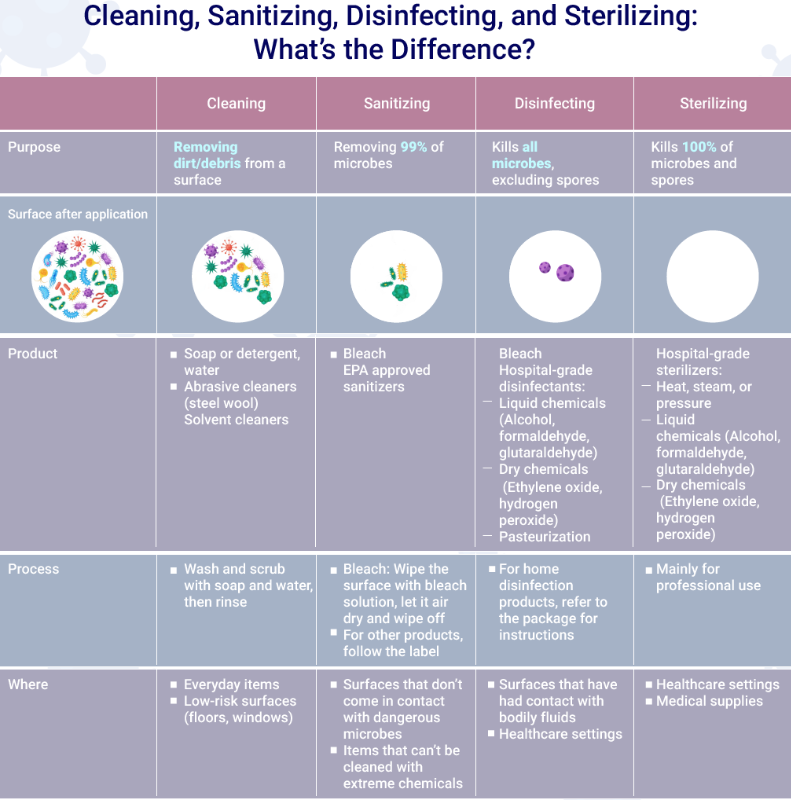
Cleaning, sanitizing, and disinfecting are good ways to keep us and our families safe, while disinfecting and sterilizing are ideal for healthcare settings. A limitation to cleaning and sanitizing is that microbes remain on the surface, meaning they can multiply and regrow on your surfaces. Disinfecting surfaces destroys all bacteria, preventing them from multiplying, but a limitation is that most disinfectants do not have long-term activity, and will not prevent new microbes from colonizing the area.
When applied and allowed to dry, Bio-Vanguard long-lasting spray creates a protective barrier that binds strongly to both hard and soft surfaces, creating conditions that inhibit the growth of 99.9% of microbes. The treated surface becomes resistant against illness- and odor-causing microbes for up to 30 days. Learn moreabout how this antimicrobial can be added to your cleaning routine to destroy microbes, and eliminate odors.
For information about bulk orders, custom formulations, or to learn more about how Bio-Vanguard can be incorporated into your products, contact us at info@bio-vanguard.com.

服务科技与工业发展 造福人类

关注微信公众号