时间: Invalid Date
作者: 百灵威
分享:
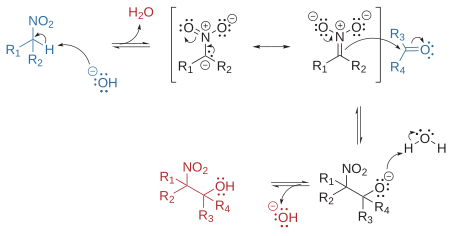
The Henry reaction uses a catalytic base to convert a nitroalkane and a ketone or aldehyde to a β-nitro alcohol. The base abstracts an α-proton from nitroalkane, producing a resonance stabilized anion, which attacks the carbonyl, to form a β-nitro alkoxide that is protonated by the base’s conjugate acid. β-nitro alcohols can be converted to nitroalkenes, α-nitro ketones, or β-amino alcohols via dehydration, oxidation, and reduction respectively.
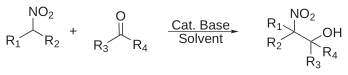
- Reagents: Catalytic Base (Alkali Metal Hydroxide, Alkoxide, Carbonate, KF, Transition Metal Complex, Amine, DBU, etc.), Solvent
- Reactant: Nitroalkane with α-Hydrogen, Aryl/Aliphatic Aldehyde or Ketone
- Product: β-Nitro Alcohol
- Type of Reaction: Nitro-Aldol Condensation
- Bond Formation: C-C
Mechanism
Original Paper
- Henry, L Compt. Rend. 1895, 120 (1), 1268.
Top Citations
Related Reactions
- Aldol Addition
Related Compounds

100万+品类
全品全覆盖,海量现货高品质

50万+瓶现货
可实现最快4小时送达

28万+服务客户
提供产品及配套技术服务
联系我们


关注微信公众号
本网站销售的化学产品仅供研发或工业应用,不直接用于食品、药品、临床诊断或治疗。
