Beckmann Rearrangement
时间: Invalid Date
作者: 百灵威
分享:
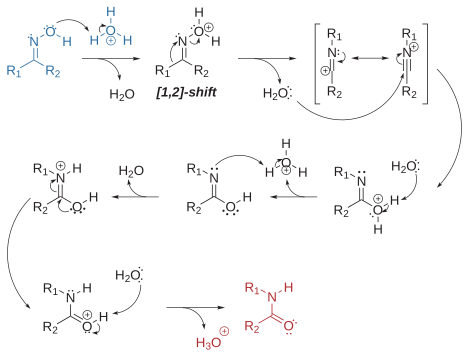
The Beckmann rearrangement involves the use of a strong acid to rearrange an oxime (aldoxime or ketoxime) to an amide. First the oxime hydroxyl group receives a proton from the acid, forming a leaving group. A [1,2]-shift of the R group, which is anti to the leaving group, then promotes its departure, resulting in a nitrilium ion, which reacts with water. Deprotonation of oxygen, protonation of the nitrogen and tautomerization produces the final amide product.
Lab Tips:- Forcing conditions (high temperatures (> 130°C) and large amounts of a strong Brӧnsted/Lewis acid) are usually required. Sensitive substrates should be avoided. [1]
- Check that the oxime does not isomerize under the reaction conditions, otherwise a mixture of two possible amides is obtained. Reagents p-toluenesulfonyl chloride and phosphorus pentachloride have been found least likely to cause competing isomerization. [2]
- Since the hydrogen atom never migrates, N-unsubstituted amides cannot be made. [1]
2. Carey, F.A., Sundberg, R.J. (2001). Advanced Organic Chemistry Part B: Reactions and Synthesis (4th ed.). New York: Kluwer Academic/Plenum Publishers.
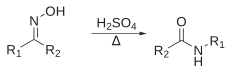
- Reagents: Strong Brӧnsted or Lewis Acid (H2SO4)
- Reactant: Oxime
- Product: N-Substituted Amide
- Type of Reaction: Rearrangement
Mechanism
Original Paper
Top Citations
Related Reactions
- Schmidt Reaction
Related Compounds

服务科技与工业发展 造福人类

关注微信公众号

北京市朝阳区大望京中心A座501
电话(QQ): 400 666 7788
电话:+86 10 59309000
传真:+86 10 8284 9933
本网站销售的化学产品仅供研发或工业应用,不直接用于食品、药品、临床诊断或治疗。
